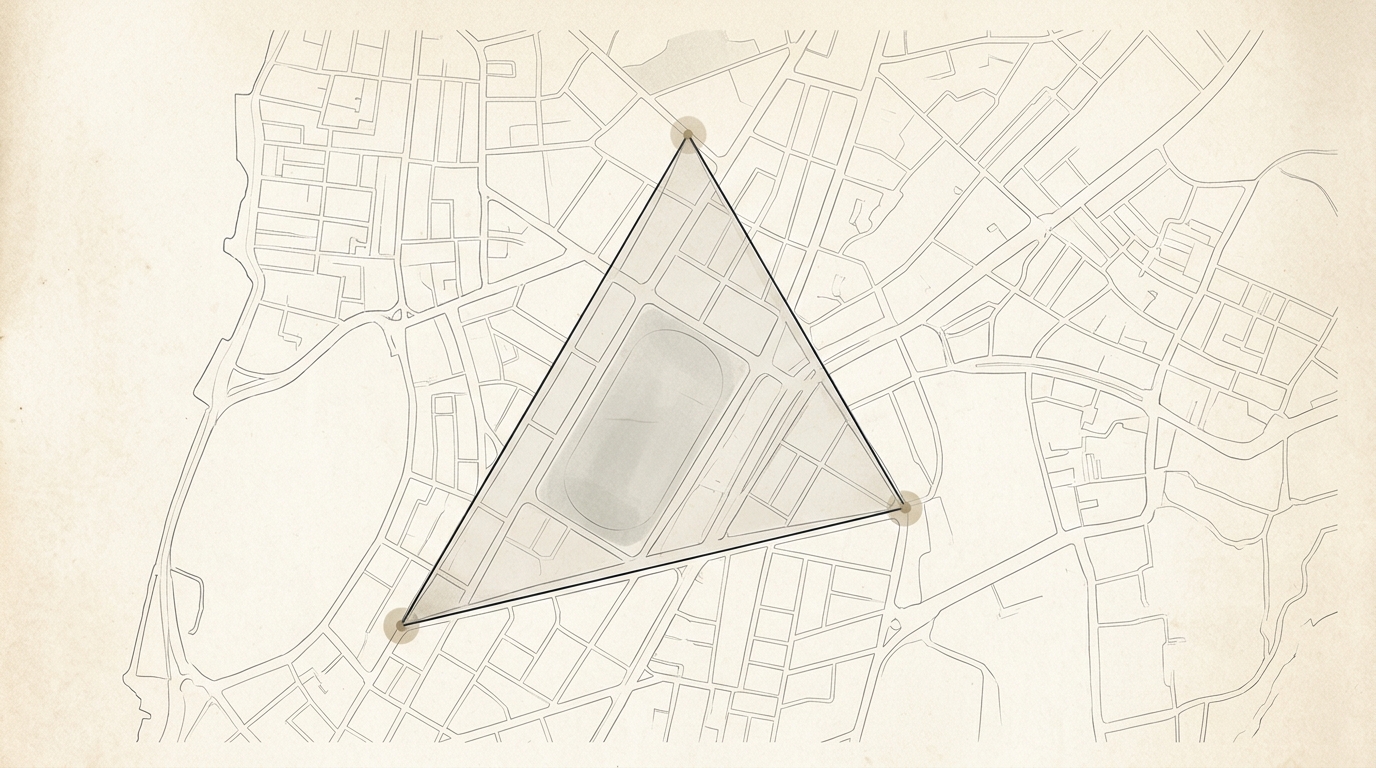
Central Mumbai has a quiet advantage that the city's discourse keeps underselling. Three of its most desirable residential neighbourhoods, Matunga, Shivaji Park and Worli, sit at the corners of a triangle roughly six kilometres on each side. The maximum drive between any two corners is twenty minutes off-peak. The minimum is eight.
If you are inside that triangle, you have access to most of what the city sells without ever spending an hour in traffic. The point of this piece is to show what that means on an ordinary Saturday.
The three corners
The triangle is anchored by three working addresses. Each one has a distinct character that does not blur into the others.
Matunga is the cultural heart. South Indian temples, hundred-year-old institutions, schools with multi-generational pull, and the densest cluster of breakfast restaurants in the city. A 3 BHK flat in Matunga, the typical product, suits families who want walking access to all of it.
Shivaji Park is the maidan. A 28-acre open ground at the centre of the neighbourhood, with the residential lanes wrapping around it. Mornings are walkers and cricket. Evenings are dog owners and political speeches. Flats near Shivaji Park Mumbai sell at a premium that the residents themselves struggle to put a number on.
Worli is the seafront. The Sea Link to the north, the Coastal Road to the south, the office towers along Worli Naka, and the long sea face that defines the address. The buyer skew is older, the cars are nicer, the doorbells get fewer interruptions.
A Saturday, hour by hour
Imagine the day starts in a flat at the Matunga corner.
6.30 am · Matunga
Out of the door, down to the King's Circle road. Cafe Mysore for filter coffee and a medu vada. A walk around the central garden. The newspaper sellers are setting up. Most of the city is still asleep.
8.00 am · Shivaji Park
A nine minute drive west. Park at the corner near Cafe Coffee Day. One slow loop around the maidan, four kilometres, takes forty-five minutes. The walkers know each other. The under-19 cricket team is doing nets at the corner.
9.30 am · Matunga
Back at Matunga in time for the older generation's breakfast at Ramashray. Idli, vada, pongal. The kitchen has not changed its menu in twenty years.
11.00 am · Worli
South along Senapati Bapat Marg toward Worli. Eleven minutes on a Saturday morning. A meeting at a Worli office on the sea face. Tea on a balcony with the Bandra-Worli Sea Link arching out into the bay. By twelve thirty the meeting is done.
1.00 pm · Lower Parel
A short loop back through Lower Parel for lunch at one of the Phoenix Marketcity restaurants. Six minutes from the Worli office. The Mills district food cluster runs through Saturday lunch reliably.
3.30 pm · Matunga
Back to the flat for a long afternoon. Twelve minutes from Lower Parel via Tilak Bridge. The 3 BHK is quiet in the afternoon. The fan is enough for the early summer.
6.00 pm · Shivaji Park
Out again. Ten minutes back to Shivaji Park for the evening hour. The light off the maidan around six thirty is the reason a lot of people moved to the area in the first place.
7.30 pm · Mahim or Worli
Dinner is a fork in the road. North to Mahim for the older Irani cafes and the seafood at Highway Gomantak. South to Worli for a newer restaurant near Worli Naka. Either way, the drive is fifteen minutes and the bill is not what it would be in Bandra.
10.00 pm · Matunga
Back home by ten. Total drive time across the day: roughly seventy minutes, spread across seven short trips. No single trip was longer than seventeen minutes.
The premium central Mumbai buyers pay is not for the building. It is for the commute that does not exist.
What the twenty minute radius adds up to
Inside the triangle, a working list of what sits comfortably inside a twenty minute drive from any of the three corners:
- Bandra-Kurla Complex, both the office cluster and the diplomatic enclave.
- Nariman Point and Fort, by the Coastal Road from the Worli corner.
- Lower Parel and Mahalaxmi, the lunch and meeting belt.
- Mahim and Bandra West, for restaurant and weekend variety.
- Sion and King's Circle, for medical infrastructure including Hinduja, Tata, Wadia and KEM.
- The four good central Mumbai schools that families repeatedly cite as decision drivers.
Outside the triangle, the city gets sticky. Bandra to Powai is forty minutes on a quiet day. Andheri to Lower Parel is fifty in the wrong direction. Thane to South Mumbai is ninety. The triangle is the rare pocket where the city's geography does not punish the resident for wanting to use it.
Why this matters for a buyer
Real estate marketing talks a lot about location. Most of the time, that conversation is about prestige. The harder, more useful question is about everyday use. How much of your actual life happens within twenty minutes of your front door? In central Mumbai, the answer for most of the working week and most of the weekend is: most of it.
A 3 BHK flat in Matunga, a flat near Shivaji Park, or a unit at one of the newer Worli buildings places the buyer inside this geometry. The premium is the commute that does not exist, the dinner that does not need a thirty minute drive, the school run that ends in eight minutes, the weekend that does not get eaten by traffic.
The next Lifestyle piece is a Matunga breakfast walk, before nine on a weekday, ground up.
Gala Habitats' three ongoing projects sit at three of the corners of this triangle: Paramount Matunga, Aakasa Shivaji Park and Aakasa Worli. The map is on the projects page.